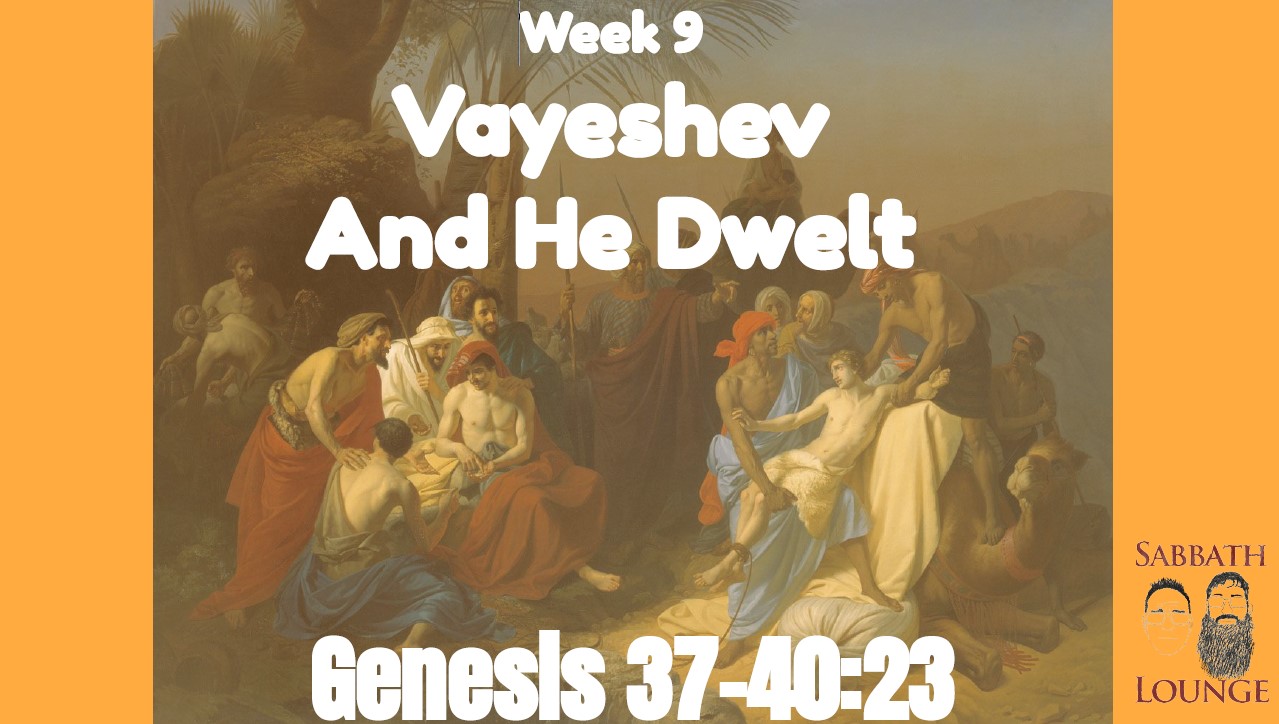
Torah Portions: Joseph to Yeshua, Week 9 – Vayeshev (Genesis 37-40:23) | Bible Study & Insights

We’re jumping into Vayeshev, which means “And he dwelt.” And no, we’re not talking about Andy — don’t worry, you’re not the only one wondering who Andy is. We’ll get to that in a minute.
Joseph: The Beloved Son
So, Vayeshev is all about Joseph, one of the key figures in the Torah. His story takes up a significant portion of the book of Genesis, and in this week’s reading (Genesis 37-40), we begin to see the rise of Joseph in his father Jacob’s household.
Right from the start, we see a comparison between Joseph and Yeshua (Jesus). Both are beloved sons of their fathers, and both are deeply loved by God. Just like Yeshua, Joseph’s father — Jacob — is delighted in him. In Matthew 3:17, God says of Yeshua, “This is my beloved Son, in whom I am well pleased.” The parallel is clear: Both Joseph and Yeshua are “the apple of their father’s eye.”
The Dreamer: Prophecy of Rule
One of the most famous parts of Joseph’s story is his dream. In Genesis 37:7, Joseph has a vision where his brothers’ sheaves of wheat bow down to his sheaf. This dream predicts that one day, Joseph will rule over his family. Similarly, in Matthew 26:64, Yeshua speaks of Himself coming on the clouds of Heaven to sit at the right hand of power. Both Joseph and Yeshua foresee a future in which they are recognized as rulers.
But of course, just like Joseph’s brothers, Yeshua faces skepticism and accusations of being “just a dreamer.” Joseph is mocked for his dreams, and his brothers say, “Here comes this dreamer!” In the same way, when Yeshua spoke about His divine mission, some thought He was “beside Himself” (Mark 3:21).
Rejected and Condemned
Both Joseph and Yeshua are rejected by those closest to them. Joseph’s brothers conspire to kill him, and in Genesis 37:18, they plot against him. Later, in Luke 19:14, the crowds cry out to crucify Yeshua. Both of these men face condemnation and rejection from those they came to serve.
Stripped and Forsaken
A significant moment in Joseph’s story comes when his brothers strip him of his coat — the symbol of his father’s favor. In Matthew 27:28, Yeshua is similarly stripped before His crucifixion. Both Joseph and Yeshua endure humiliation and rejection, yet these acts play a key role in their eventual restoration and victory.
It’s also worth noting the famous story of Joseph’s coat. The phrase “coat of many colors” has become iconic, but interestingly, the Hebrew doesn’t actually say it’s a coat of many colors. This translation has evolved over time, but in reality, the word used could refer to something more like a “long-sleeved” or “ornate” coat. Just a little side note for those of you who love digging deeper into these stories!
Sold for Silver
Here’s where the comparisons get even more interesting: Joseph is sold by his brothers for 20 pieces of silver, and in Matthew 26:14-16, Yeshua is betrayed by Judas for 30 pieces of silver. Both are handed over to Gentiles and experience a form of abandonment. Yet, just as Joseph’s journey eventually leads to his brothers’ salvation, Yeshua’s sacrifice leads to the salvation of the world.
Temptation and False Accusations
Joseph resists temptation when Potiphar’s wife tries to seduce him. He refuses to sin, and in Genesis 39, he runs from the situation. Yeshua, too, faces temptation — both in the wilderness after His baptism and in His final moments before His crucifixion. In Hebrews 4:15, we read that Yeshua was tempted in all points as we are, yet without sin. Both Joseph and Yeshua model perfect resistance to sin, despite the pressure they face.
They are also both falsely accused. In Genesis 39:17, Joseph is wrongly accused by Potiphar’s wife, and in Matthew 26:59-61, false witnesses are brought against Yeshua. Yet, in both cases, God’s plan prevails, and they are vindicated.
Deliverance and Resurrection
Joseph is cast into a pit and left for dead, but he’s eventually lifted out. Yeshua, too, is buried in a tomb for three days and three nights, but rises again, as prophesied. In both stories, there is an ultimate deliverance, and both Joseph and Yeshua bring salvation to their people.
Joseph, having endured hardship, becomes a ruler who will provide for his family during a time of famine. Similarly, Yeshua, after His death and resurrection, becomes the Savior who provides eternal life to all who believe in Him.
Conclusion: A Torah Connection
As we look at these amazing parallels between Joseph and Yeshua, we realize that these stories are not just ancient history — they are part of a bigger narrative. They point to the ultimate story of salvation and God’s plan for His people. The parallels between Joseph’s life and Yeshua’s mission are profound, and they encourage us to dig deeper into the text and find the lessons God has for us.
So, what do we take away from all of this? As we study Joseph’s life, let it remind us of Yeshua’s sacrifice and how both of these figures were sent by the Father, rejected by men, and ultimately glorified. It’s a reminder of the importance of persevering through trials, trusting in God’s plan, and understanding the deeper meanings in Scripture.
Thanks again for tuning in to Shabbat Lounge. We hope this post has sparked some new insights for you, and as always, we encourage you to dive deeper into the Word. If anything we’ve shared today intrigues you, go back, study the Scriptures, and see what God is revealing to you.
We’ll be back next time with more on Joseph’s story. Until then, Shabbat Shalom!
Summary
- Joseph and Yeshua parallels
- Torah portion Vayeshev
- Joseph’s dreams and Yeshua’s prophecy
- Bible study Joseph and Jesus
- Shabbat Lounge podcast
How Joseph is like Yeshua
| Characteristic | Joseph | Yeshua |
|---|---|---|
| Miraculous Birth | Born to Rachel, a miraculous birth in the family | Born of a virgin, conceived by the Holy Spirit |
| Obedient to Fathers/Business | Obedient to Jacob, was about his father’s business | Obedient to God the Father, was about His Father’s business |
| Purity | No sin written about him | No sin written about Him |
| Sent to Check on Brothers | Sent by Jacob to check on his brothers | Sent by God to the 12 tribes of Israel |
| Rejected by Brothers | Rejected by his brothers (Joseph’s brothers sold him) | Rejected by His people (the Jews) |
| Conspiracy to Kill | Judah conspires to sell him for 20 pieces of silver | Judas betrays Him for 30 pieces of silver |
| Went Peacefully, Did Not Fight | Went peacefully, did not resist | Went peacefully, did not resist |
| Blood Shed, Clothes Torn | Blood shed (sold into slavery), clothes torn (coat) | Blood shed on the cross, clothes torn during the crucifixion |
| Prepared a Place for Family | Went to Egypt to prepare for a famine | Went to Heaven to prepare a place for His followers |
| Garments Left Behind | Coat of many colors (symbol of royalty) left behind | Shroud left behind (after crucifixion) |
| Falsely Accused | Falsely accused of wrongdoing (by Potiphar’s wife) | Falsely accused and convicted (by religious leaders) |
| Dreams Fulfilled | Joseph’s dreams were fulfilled (his brothers bowing) | Yeshua’s life fulfilled prophetic dreams and scriptures |
| Coat of Colors as Royalty | Coat represented royal favor from his father | Yeshua represented the “King of Kings” despite earthly rejection |
| Brings Unity to the Family | Brings reconciliation to his family (after famine) | Brings reconciliation to the family of Israel and the world |
| Families Help After Sin Conviction | Brothers did not help until they were convicted of their sin | Disciples and people help after recognizing their sin |
| Beaten, Stripped, Persecuted | Beaten and persecuted for his faithfulness | Beaten and persecuted for the sake of humanity |
| By His Wounds We Are Healed | Joseph’s suffering led to saving his family | By Yeshua’s wounds, we are spiritually healed |
| Tempted to Sin but Rejected It | Tempted by Potiphar’s wife, rejected sin | Tempted by Satan in the desert, rejected sin |
| Innocent but Suffered | Joseph was innocent but suffered unjustly | Yeshua was innocent but suffered unjustly |
| Saved Family Through Suffering | His suffering ultimately saved his family | His suffering saved humanity |
| Not Recognized Until the Right Time | His brothers did not recognize him until later | People did not recognize Him until after His resurrection |
| Went Before the King | Went before Pharaoh and interpreted dreams | Went before Pilate and did not defend Himself |
| Right Hand of the King/Father | Right hand of Pharaoh, second in command | Right hand of God the Father, supreme authority |
| Loved by Father More than Others | Loved more by Jacob (his father) than his brothers | Loved by God the Father more than all others (Matthew 3) |
| Forgives Those Who Wronged Him | Forgives his brothers and provides for them | Forgives those who crucified Him |
| Restores Family | Reunites with his brothers and saves them | Restores the relationship between God and humanity |
| Slow to Anger | Slow to anger, shows mercy towards his brothers | Slow to anger, shows mercy to those who wronged Him |
| Servant Leadership | A servant leader in Egypt | A servant leader in His ministry |
| Elevated Above Others | Elevated to a high position in Egypt | Elevated to the right hand of God |
| Baker, Butler (Thief on Cross) | Interpreted the dreams of the baker and butler | One thief was saved, the other condemned to eternal death |
| Bread of Life | Prepared food (bread) during famine | Yeshua is the Bread of Life (spiritual sustenance) |
| Reunited Israel After Division | United Israel by saving them from famine | Unites the people of Israel and the world in salvation |
| Shocking Revelation | His brothers were shocked to see him as the second-in-command | Christians will be shocked when Yeshua reveals Himself at His return |
| Went to Egypt | Fled to Egypt to escape danger | Went to Egypt with His family to escape Herod’s decree |
| Spoke for the Father | Represented and spoke for Pharaoh | Represented and spoke for God the Father |
The Names of the 12 tribes
| Tribe | Meaning | Tribe Significance/Reflection |
|---|---|---|
| Reuben | “Behold, a son” | Represents acknowledging divine judgment and the importance of Yah’s will in our lives. |
| Simeon | “One who hears” | Signifies listening and hearing Yah’s voice, and the calling to follow His commands. |
| Levi | “Joined” or “Attached” | Symbolizes being joined to Yah’s family and covenant, emphasizing union with the Creator. |
| Judah | “Praise” | Reflects the importance of worship and praise in acknowledging Yah’s sovereignty and faithfulness. |
| Dan | “Judge” | Represents judgment and discerning truth, often pointing to the responsibility of leadership. |
| Naphtali | “My struggle” or “Wrestling” | Highlights the spiritual struggle and wrestling with our own nature, seeking Yah’s victory. |
| Gad | “Fortune” or “Troop” | Reflects the blessings and abundance Yah provides as a result of His grace and providence. |
| Asher | “Happy” or “Blessed” | Signifies the joy that comes from following Yah and being blessed in our obedience. |
| Issachar | “There is recompense” or “Reward” | Represents wisdom, understanding, and the reward that comes from fulfilling divine purpose. |
| Zebulun | “Dwelling” or “Honorable” | Reflects the calling to occupy and work for Yah’s kingdom, engaging in purposeful action. |
| Joseph | “He will add” | Symbolizes increase, fruitfulness, and the blessings Yah bestows in response to faithfulness. |
| Benjamin | “Son of the right hand” | Represents being in a position of favor, strength, and support from Yah’s right hand. |


Leave a comment