
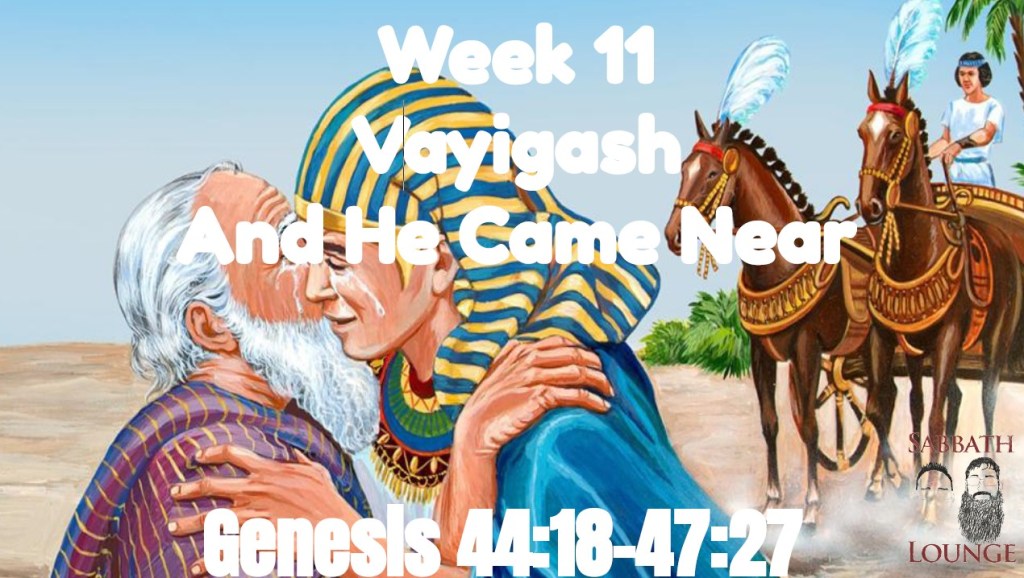
Week 11 Vayigash (and Came Near)
Genesis 44:18-47:27
This week, we’re focusing on the Torah portion Vayigash, which means “And He Came Near.” Sounds like something is about to go down, right? So, let’s unpack what this portion is really about. The key scripture here is from Genesis 44:18 to 47:27. So, what does “he came near” mean? Well, let’s find out together.
The Key Moment: Judah’s Growth
This week’s portion shows Judah stepping up, and this character has much growth. Judah is willing to take the burden for the loss of a beloved son, Benjamin, his brother. This shows a fundamental change in him. Earlier in his life, Judah might have turned away from his responsibilities, but now he is willing to cover for Benjamin, which is a big deal. This could be seen as a redemption arc, similar to the transformation of Judas in the New Testament. The parallel is interesting. Judas realizes the gravity of his actions regarding Yeshua and repents, just like Judah now takes on responsibility for his brother.
The Prodigal Son Parallels
Speaking of redemption, there’s an interesting tie-in with the Prodigal Son story. If you know the story, you’ll remember that the older brother is not too happy when the younger one returns and is treated with compassion. Judah, in this case, plays the role of an older brother. He’s defending Benjamin, much like the older brother in the prodigal story might have defended the family’s honor. Joseph, who we might think of as the ‘younger brother’ in some ways, has already suffered and been cast out, and now his brothers are coming back, realizing their mistakes.
Joseph’s emotional reaction to all this is poignant. It’s easy to criticize him for crying, but if you put yourself in his shoes, it’s understandable. Joseph has been through a lot. He’s been separated from his family for years, and now, to see them standing before him, unaware of his true identity, it’s a lot for anyone to handle.
Joseph Reveals Himself
Eventually, Joseph reveals himself to his brothers, and the moment is full of emotion. Joseph tells them Elohim went before him to preserve life, which ties into a greater spiritual narrative. It shows how God’s hand was guiding Joseph all along. This is a symbolic moment, as it points to the future glory that will be revealed in the messianic era when all things are restored and God’s plan for His people is fully realized.
A Royal Reunion
Pharaoh, the king of Egypt, sends a royal escort to bring Jacob and the rest of the family to Egypt. This is not just any ordinary caravan—it’s a procession with all the pomp and circumstance you could imagine. Joseph, who was once a lowly prisoner, is now second in command, and he uses his newfound power to gather his family. This reflects the idea of the Father calling His people back, with all the fanfare and glory of the bride’s return to the groom.
The Bride and the Groom
Let’s talk about the bride and groom imagery in this story. In this case, Joseph is the groom, and Jacobis’s Israelite family is the bride. There’s much bridal language throughout the scriptures, and here, it seems that Joseph represents the groom coming to reclaim his bride. Jacob and his family, representing Israel, are the bride being called out of the land of famine (Canaan) and into the land of plenty (Goshen) in Egypt. This story is packed with layers of meaning, and the deeper you dive, the more you find.
The Two Houses: Northern and Southern Kingdoms
Another interesting aspect of this story is the symbolism of Israel’s Northern and Southern Kingdoms. Having been separated from his family and assimilated into Egyptian culture, Joseph represents the Northern Kingdom, while Judah and the rest of the family represent the Southern Kingdom. This reunion of Joseph and his brothers can be seen as a foreshadowing of the reunification of these two houses, which would occur in the Messianic age. The long separation between the two kingdoms is finally ending, and we see the beginning of their restoration.
Joseph’s Plan and Egypt’s Enslavement
Now, let’s look at Joseph’s plan for Egypt. There’s a famine, and people come to Joseph for food. They offer him money, land, and, eventually, their lives. It’s a picture of total dependence on Joseph and reflects what can happen when people are in spiritual famine. Sound familiar? We’re in a famine of the Word today, and many people are spiritually hungry, relying on what the world offers instead of turning to the truth found in the Scriptures.
Joseph’s Marriage and Its Deeper Meaning
Joseph is the only patriarch who is mentioned as having only one wife. This is interesting, especially when compared to the other patriarchs like Abraham, Isaac, and Jacob. His wife, Asenath, is from Egypt and has a background in Babylonian culture. But just as Joseph was called out of Egypt and Egypt’s ways, Asenath was also called out of Babylonian customs and learned Joseph’s ways. This reflects how the bride of Messiah is called out of the world and its ways to become one with the groom, just as Asenath became one with Joseph.
Conclusion
This portion of scripture is so rich with meaning. It’s not just about a family reunion but also a picture of spiritual restoration, the reunification of the Kingdoms of Israel, and the bride being called out of the world to be with her groom. There are layers upon layers of symbolism here, and as we study, we begin to see how this story mirrors our journey of returning to the Father.
We encourage you to dig deeper into this story and study the Torah portions. There is so much more here than just a historical narrative—it’s alive with spiritual truths relevant to us today.
Meaning of The Tribes of Israel (Genesis 48)
| Tribe | Blessing | Key Names of God Used | Scripture Reference |
|---|---|---|---|
| Manasseh | Jacob blesses Manasseh, giving him the firstborn status despite being the younger of Joseph’s two sons. He blesses Manasseh with a future of prosperity and greatness. | El Shaddai (God Almighty) | Genesis 48:13-20 |
| Ephraim | Ephraim, the younger of Joseph’s two sons, receives the blessing of becoming greater than Manasseh. Jacob crosses his hands and blesses Ephraim as the leader of Joseph’s descendants. | El Shaddai (God Almighty) | Genesis 48:13-20 |
| Reuben | Reuben, the firstborn son of Jacob, loses his birthright for his sinful actions. He is described as unstable like water. His tribe will not excel. | El Shaddai (God Almighty) | Genesis 49:3-4 |
| Simeon | Simeon and Levi are cursed for their violence and anger. Their tribe will be scattered among Israel. | Yahweh (The LORD) | Genesis 49:5-7 |
| Levi | Similar to Simeon, Levi is rebuked for his violent nature but later receives the priestly role, being scattered throughout Israel but given cities to dwell in. | Yahweh (The LORD) | Genesis 49:5-7 |
| Judah | Judah is blessed with leadership. Jacob prophesies that the kingship will come from Judah’s descendants, culminating in the Messiah (a reference to David and Jesus). | Yahweh (The LORD) | Genesis 49:8-12 |
| Zebulun | Zebulun is blessed with prosperity and will dwell by the sea, becoming a prosperous place for trade and commerce. | El Shaddai (God Almighty) | Genesis 49:13 |
| Issachar | Issachar is described as a strong donkey who will become a servant to others, symbolizing hardworking and loyal people. | Yahweh (The LORD) | Genesis 49:14-15 |
| Dan | Dan is blessed with the role of a judge, but Jacob also prophesies that Dan will be a serpent in the way, a symbol of his later role in causing division in Israel. | El Shaddai (God Almighty) | Genesis 49:16-18 |
| Gad | Gad’s tribe is blessed with victory in battle, although they will face attacks, they will overcome them. | Yahweh (The LORD) | Genesis 49:19 |
| Asher | Asher’s descendants will be blessed with abundance, with rich food and royal delicacies. | El Shaddai (God Almighty) | Genesis 49:20 |
| Naphtali | Naphtali is blessed with freedom and speaks beautiful words, symbolizing a tribe that will bring a message of peace. | Yahweh (The LORD) | Genesis 49:21 |
| Joseph | Joseph is blessed with fruitful prosperity, despite the challenges he faced. His blessings surpass those of his brothers. Jacob invokes El Shaddai to bless him. | El Shaddai (God Almighty), Yahweh | Genesis 49:22-26 |
| Benjamin | Benjamin is blessed as a ravenous wolf, symbolizing his descendants’ strength and prowess in battle. | Yahweh (The LORD) | Genesis 49:27-29 |


Leave a comment